
Benefits of Activated Carbon Filber (ACF)
What is Activated Carbon Fiber (ACF)?
What is Activated Carbon?
Activated carbon is a porous carbon material used to adsorb organic compounds, odors, and other impurities from liquids and gases. Its many tiny pores, known as micropores, create a large surface area that attracts molecules through adsorption.
Activated carbon is widely used in water purification, air purification, deodorization, and industrial filtration applications.
Types and Materials of Activated Carbon
Activated carbon is commonly made from raw materials such as wood, coconut shell, and coal. It can be processed into several forms, including granular, powdered, pelletized, and fibrous types.
UNITIKA activated carbon filters use fibrous activated carbon as the key material. This activated carbon fiber media provides distinctive advantages in adsorption speed, pressure drop, and filter design flexibility.
Activated Carbon Fiber vs. Granular Activated Carbon
The performance of activated carbon depends on its pore structure, pore distribution, raw material, activation process, and physical shape.
Activated carbon fiber has many micropores on or near the fiber surface. This structure allows target substances to reach adsorption sites quickly, resulting in faster adsorption performance than conventional granular activated carbon.
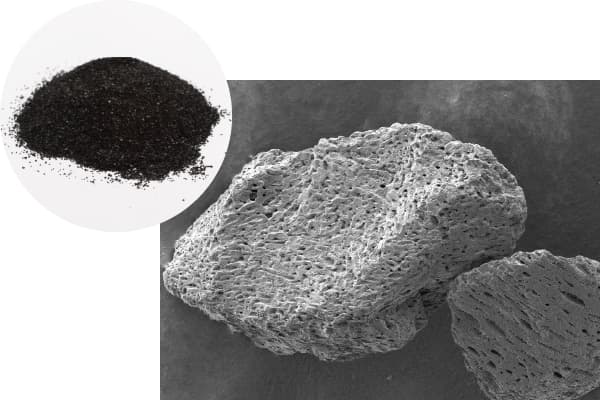
In granular activated carbon, target substances often need to move through larger pores before reaching internal micropores. This multi-step diffusion process can slow down adsorption, especially under high-flow conditions.
Because of its surface-accessible micropore structure, activated carbon fiber is suitable for applications that require fast adsorption, compact filter design, and stable performance at high filtration speeds.
| Shape | Fibrous | Granular |
|---|---|---|
| Appearance | 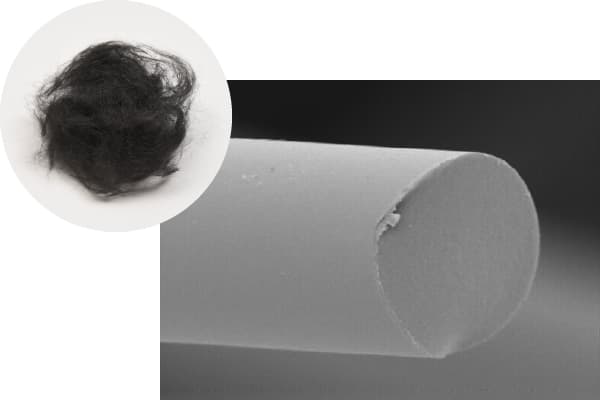 |
 |
| Pore structure | 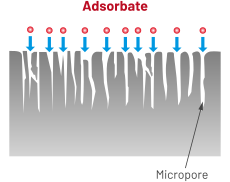
Adsorbates can be adsorbed without diffusive transfer due to micropores on the surface, which achieves faster adsorption. |
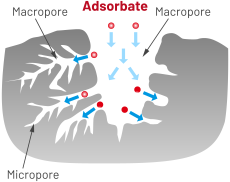
Multi-step diffusive transfer is necessary due to micropores inside macropores. |
What Can UNITIKA ACF Filters Reduce?
| For water purification | For air purification |
|---|---|
| Free chlorine | Hydrocarbons, Aromatic hydrocarbons |
| Odors (Geosmin, 2-Methylisoborneol) | Aldehydes |
| Pesticides (Simazine, Atrazine etc.) | Ammonia |
| Trihalomethane (Chloroform) | Amines |
| Heavy metals* (Lead, Mercury, Cadmium, Copper) | Hydrogen Sulfide |
| PFAS | NOx, SOx |
* Only our grey/white filters containing our ion exchanger
Key Advantages of ACF for Water and Air Purification
Advantages of ACF for Water and Air Purification:
- - Rapid adsorption: Surface micropores allow contaminants to reach adsorption sites quickly.
- - Effective adsorption at high flow rates: Rapid adsorption kinetics help maintain filtration performance even when contact time is short.
- - Low pressure drop and reduced clogging: The open fibrous structure allows water and air to pass through with less resistance.
- - Compact filter design: The rapid adsorption performance of ACF supports smaller filter designs for space-limited applications.
Suitable Applications
ACF is particularly suitable for applications requiring rapid adsorption, low flow resistance, or a compact filter design.
- - Compact water purification systems, including faucet-mounted filters, water filter pitchers, bottles, and portable water purifiers
- - Gravity-fed water filtration systems
- - High-flow water filtration systems with limited contact time
- - Automotive cabin air filters and air-conditioning systems
- - Household and commercial air purifiers for odor and VOC reduction